Lex Bona Fide – Law Firm & Advocates

Categories
Blogs

Operational Creditor vs Financial Creditor under IBC – Key Differences Explained

The Insolvency and Bankruptcy Code, 2016 (IBC), introduced a structured and time-bound mechanism for resolving the insolvency of corporate entities in India. One of the most important distinctions under the IBC is between Operational Creditors and Financial Creditors.

Understanding the difference between these two categories is crucial because their rights, remedies, and powers under the IBC are significantly different.

This article explains the meaning, legal position, rights, and differences between Operational Creditors and Financial Creditors under the IBC, with practical clarity.


Who Is a Creditor under the IBC?

A creditor is any person or entity to whom a debt is owed by the corporate debtor. Under the IBC, creditors are broadly classified into:

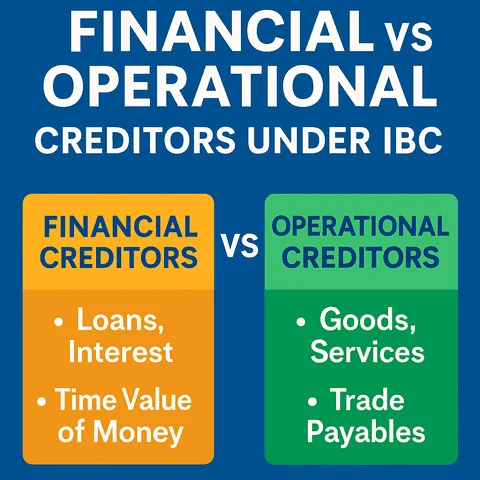
  • Financial Creditors

  • Operational Creditors

This classification determines who can initiate insolvency, who controls the process, and who has voting rights.


Who Is a Financial Creditor?

A Financial Creditor is a person to whom a financial debt is owed.

What Is Financial Debt?

Financial debt refers to money borrowed against the consideration for time value of money.

Common Examples of Financial Creditors:

  • Banks and financial institutions

  • NBFCs

  • Bondholders and debenture holders

  • Lenders who have disbursed loans

  • Persons who have provided credit facilities

The essence of financial debt is lending of money with interest or repayment obligation over time.


Who Is an Operational Creditor?

An Operational Creditor is a person to whom an operational debt is owed.

What Is Operational Debt?

Operational debt arises from:

  • Supply of goods

  • Rendering of services

  • Employment-related dues

  • Statutory dues payable to government authorities

Common Examples of Operational Creditors:

  • Suppliers and vendors

  • Service providers

  • Employees and workmen

  • Government authorities (tax, GST, PF, etc.)

Operational creditors are generally involved in the day-to-day operations of the company.


Key Differences Between Operational Creditor and Financial Creditor

Basis Financial Creditor Operational Creditor
Nature of Debt Financial debt Operational debt
Time Value of Money Present Absent
Examples Banks, lenders, NBFCs Suppliers, vendors, employees
Right to File IBC Yes Yes
Threshold for Filing As per prescribed minimum Same threshold
Committee of Creditors Member Not a member
Voting Rights Yes No
Control Over CIRP High Limited

Who Can Initiate Insolvency Proceedings?

Financial Creditors

Financial creditors can directly file an application for initiation of Corporate Insolvency Resolution Process (CIRP) on occurrence of default.

Key advantage:

  • No prior demand notice required


Operational Creditors

Operational creditors must first:

  • Issue a demand notice to the corporate debtor

  • Wait for the statutory response period

Only if the debt remains unpaid and undisputed can insolvency proceedings be initiated.


Role in Committee of Creditors (CoC)

Financial Creditors

  • Form the Committee of Creditors

  • Have voting rights

  • Decide key aspects such as:

    • Appointment of Resolution Professional

    • Approval of resolution plan

    • Liquidation decisions

Operational Creditors

  • Do not form part of the CoC

  • May attend meetings if their dues exceed a prescribed limit

  • Have no voting rights

This distinction makes financial creditors significantly more powerful under the IBC framework.


Treatment in Resolution Plan

  • Financial creditors have a priority role in negotiation and approval of resolution plans

  • Operational creditors must receive at least:

    • Amount payable in liquidation, or

    • Amount specified under the resolution plan

However, operational creditors cannot dictate terms of the plan.


Can Operational Creditors Be Treated at Par with Financial Creditors?

Judicial precedents have clarified that:

  • Financial creditors and operational creditors form separate classes

  • Differential treatment is permissible

  • Equality does not mean identical treatment

The rationale is based on the nature of debt and risk undertaken.


Which Creditor Is in a Stronger Position?

From an insolvency perspective:

  • Financial creditors are in a stronger position due to:

    • Voting rights

    • Control over CIRP

    • Commercial decision-making powers

However, operational creditors often use IBC as an effective pressure mechanism for recovery and settlement.


Strategic Considerations Before Filing IBC

Before initiating insolvency, creditors should consider:

  • Existence of dispute

  • Amount of default

  • Commercial viability of insolvency

  • Availability of alternative remedies

IBC is not meant to be used purely as a recovery tool, though it often leads to settlements.


Conclusion

The distinction between Operational Creditors and Financial Creditors under the IBC is fundamental to insolvency law in India. While both have the right to initiate insolvency proceedings, financial creditors enjoy greater control and decision-making authority.

Understanding this difference helps creditors choose the correct legal strategy and avoid procedural pitfalls before the NCLT.


FAQs – Operational vs Financial Creditor under IBC

Q1. Can an operational creditor become a financial creditor?
No, classification depends on the nature of debt, not the amount.

Q2. Do operational creditors get voting rights?
No, they do not have voting rights in the CoC.

Q3. Is a homebuyer a financial creditor?
Yes, homebuyers are treated as financial creditors under IBC.

Q4. Can government dues be operational debt?
Yes, statutory dues fall under operational debt.

Categories
Blogs

How to Draft a Legally Enforceable Agreement in India – Complete Legal Guide

In India, agreements form the backbone of personal, commercial, and corporate transactions. However, not every agreement is legally enforceable. Many disputes arise because agreements are poorly drafted, vague, or legally invalid.

This article explains how to draft a legally enforceable agreement in India, the essential legal requirements under Indian law, common drafting mistakes, and practical tips to ensure your agreement stands strong in court.


What Is a Legally Enforceable Agreement?

A legally enforceable agreement is one that creates lawful obligations between parties and can be enforced by a court of law if breached.

Under Indian law, an agreement becomes enforceable only when it satisfies the conditions laid down under the Indian Contract Act, 1872.


Essential Elements of a Legally Enforceable Agreement in India

To draft a valid and enforceable agreement, the following elements are mandatory:

1. Offer and Acceptance

There must be:

  • A clear and definite offer by one party, and

  • Unconditional acceptance by the other party

The acceptance must match the offer exactly. Any variation results in a counter-offer, not acceptance.


2. Lawful Consideration

Consideration means something of value exchanged between parties, such as:

  • Money

  • Services

  • Goods

  • Forbearance or promise to do something

Agreements without consideration are generally void, except in limited circumstances recognised by law.


3. Free Consent of Parties

Consent must be free and voluntary. An agreement is not enforceable if consent is obtained through:

  • Coercion

  • Undue influence

  • Fraud

  • Misrepresentation

  • Mistake

Free consent is a critical factor examined by courts in contractual disputes.


4. Competent Parties

All parties must be legally competent, meaning:

  • They must be major (18 years or above)

  • Of sound mind

  • Not disqualified by law

Agreements involving minors are void and unenforceable in India.


5. Lawful Object

The purpose of the agreement must be lawful. Agreements are void if they:

  • Involve illegal activities

  • Defeat the provisions of law

  • Are against public policy

Courts will not enforce agreements with unlawful objects, even if both parties consented.


6. Certainty and Clarity of Terms

An agreement must be clear, precise, and unambiguous. Vague terms such as:

  • “As mutually decided later”

  • “Reasonable amount”

  • “As per understanding”

often make agreements unenforceable.


7. Possibility of Performance

The obligations under the agreement must be practically and legally possible to perform. Agreements requiring impossible acts are void.


Important Clauses Every Agreement Must Contain

A well-drafted agreement should include the following key clauses:

Parties Clause

Clearly identify all parties with:

  • Full legal name

  • Address

  • Description (individual/company/LLP)


Scope of Work / Subject Matter

Define:

  • Nature of obligations

  • Deliverables

  • Timelines

  • Responsibilities of each party

This clause avoids future disputes and confusion.


Consideration and Payment Terms

Specify:

  • Amount payable

  • Mode of payment

  • Payment schedule

  • Late payment consequences

Ambiguous payment clauses are a common cause of litigation.


Term and Termination

Mention:

  • Duration of the agreement

  • Grounds for termination

  • Notice period

  • Consequences of termination


Breach and Remedies

Define what constitutes a breach and the remedies available, including:

  • Damages

  • Specific performance

  • Termination rights


Dispute Resolution Clause

A strong dispute resolution clause should mention:

  • Arbitration or litigation

  • Jurisdiction of courts

  • Applicable law

This clause saves time and legal costs.


Confidentiality Clause

Essential for:

  • Business agreements

  • Employment contracts

  • Consultancy arrangements


Indemnity and Limitation of Liability

Protects parties from losses arising due to:

  • Breach

  • Negligence

  • Third-party claims


Stamp Duty and Registration – Are They Mandatory?

Stamp Duty

  • Stamp duty is mandatory for most agreements

  • Insufficient stamping can make an agreement inadmissible in evidence

Stamp duty varies from state to state.


Registration

Registration is compulsory for certain agreements, such as:

  • Lease agreements exceeding 11 months

  • Sale agreements

  • Conveyance deeds

Unregistered agreements may lose legal enforceability.


Common Mistakes to Avoid While Drafting Agreements

  • Using generic templates without legal review

  • Copy-pasting clauses from the internet

  • Not defining dispute resolution mechanism

  • Incorrect jurisdiction clause

  • Ignoring stamp duty and registration requirements

These mistakes often weaken the agreement during litigation.


Why You Should Get Agreements Drafted by a Lawyer

A professionally drafted agreement:

  • Protects your legal rights

  • Minimises future disputes

  • Stands strong in court

  • Is customised to your transaction

A lawyer ensures compliance with current laws, judicial precedents, and practical enforceability.


Conclusion

Drafting a legally enforceable agreement in India requires more than just putting terms on paper. It demands legal precision, clarity, and statutory compliance. Whether it is a business contract, recovery agreement, or commercial arrangement, proper drafting is essential to safeguard your interests.

If you want your agreement to be legally sound, enforceable, and dispute-proof, professional legal assistance is always recommended.


FAQs – Legally Enforceable Agreements in India

Q1. Is notarisation compulsory for agreements?
No, notarisation is not compulsory unless required by law or for evidentiary value.

Q2. Are oral agreements enforceable in India?
Yes, but they are difficult to prove in court. Written agreements are always preferred.

Q3. Can agreements be signed digitally?
Yes, digital signatures are valid if compliant with applicable law.