Lex Bona Fide – Law Firm & Advocates

Categories
Blogs

Operational Creditor vs Financial Creditor under IBC – Key Differences Explained

The Insolvency and Bankruptcy Code, 2016 (IBC), introduced a structured and time-bound mechanism for resolving the insolvency of corporate entities in India. One of the most important distinctions under the IBC is between Operational Creditors and Financial Creditors.

Understanding the difference between these two categories is crucial because their rights, remedies, and powers under the IBC are significantly different.

This article explains the meaning, legal position, rights, and differences between Operational Creditors and Financial Creditors under the IBC, with practical clarity.


Who Is a Creditor under the IBC?

A creditor is any person or entity to whom a debt is owed by the corporate debtor. Under the IBC, creditors are broadly classified into:

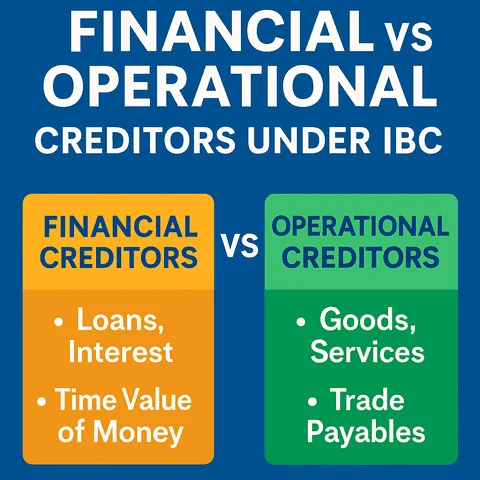
  • Financial Creditors

  • Operational Creditors

This classification determines who can initiate insolvency, who controls the process, and who has voting rights.


Who Is a Financial Creditor?

A Financial Creditor is a person to whom a financial debt is owed.

What Is Financial Debt?

Financial debt refers to money borrowed against the consideration for time value of money.

Common Examples of Financial Creditors:

  • Banks and financial institutions

  • NBFCs

  • Bondholders and debenture holders

  • Lenders who have disbursed loans

  • Persons who have provided credit facilities

The essence of financial debt is lending of money with interest or repayment obligation over time.


Who Is an Operational Creditor?

An Operational Creditor is a person to whom an operational debt is owed.

What Is Operational Debt?

Operational debt arises from:

  • Supply of goods

  • Rendering of services

  • Employment-related dues

  • Statutory dues payable to government authorities

Common Examples of Operational Creditors:

  • Suppliers and vendors

  • Service providers

  • Employees and workmen

  • Government authorities (tax, GST, PF, etc.)

Operational creditors are generally involved in the day-to-day operations of the company.


Key Differences Between Operational Creditor and Financial Creditor

Basis Financial Creditor Operational Creditor
Nature of Debt Financial debt Operational debt
Time Value of Money Present Absent
Examples Banks, lenders, NBFCs Suppliers, vendors, employees
Right to File IBC Yes Yes
Threshold for Filing As per prescribed minimum Same threshold
Committee of Creditors Member Not a member
Voting Rights Yes No
Control Over CIRP High Limited

Who Can Initiate Insolvency Proceedings?

Financial Creditors

Financial creditors can directly file an application for initiation of Corporate Insolvency Resolution Process (CIRP) on occurrence of default.

Key advantage:

  • No prior demand notice required


Operational Creditors

Operational creditors must first:

  • Issue a demand notice to the corporate debtor

  • Wait for the statutory response period

Only if the debt remains unpaid and undisputed can insolvency proceedings be initiated.


Role in Committee of Creditors (CoC)

Financial Creditors

  • Form the Committee of Creditors

  • Have voting rights

  • Decide key aspects such as:

    • Appointment of Resolution Professional

    • Approval of resolution plan

    • Liquidation decisions

Operational Creditors

  • Do not form part of the CoC

  • May attend meetings if their dues exceed a prescribed limit

  • Have no voting rights

This distinction makes financial creditors significantly more powerful under the IBC framework.


Treatment in Resolution Plan

  • Financial creditors have a priority role in negotiation and approval of resolution plans

  • Operational creditors must receive at least:

    • Amount payable in liquidation, or

    • Amount specified under the resolution plan

However, operational creditors cannot dictate terms of the plan.


Can Operational Creditors Be Treated at Par with Financial Creditors?

Judicial precedents have clarified that:

  • Financial creditors and operational creditors form separate classes

  • Differential treatment is permissible

  • Equality does not mean identical treatment

The rationale is based on the nature of debt and risk undertaken.


Which Creditor Is in a Stronger Position?

From an insolvency perspective:

  • Financial creditors are in a stronger position due to:

    • Voting rights

    • Control over CIRP

    • Commercial decision-making powers

However, operational creditors often use IBC as an effective pressure mechanism for recovery and settlement.


Strategic Considerations Before Filing IBC

Before initiating insolvency, creditors should consider:

  • Existence of dispute

  • Amount of default

  • Commercial viability of insolvency

  • Availability of alternative remedies

IBC is not meant to be used purely as a recovery tool, though it often leads to settlements.


Conclusion

The distinction between Operational Creditors and Financial Creditors under the IBC is fundamental to insolvency law in India. While both have the right to initiate insolvency proceedings, financial creditors enjoy greater control and decision-making authority.

Understanding this difference helps creditors choose the correct legal strategy and avoid procedural pitfalls before the NCLT.


FAQs – Operational vs Financial Creditor under IBC

Q1. Can an operational creditor become a financial creditor?
No, classification depends on the nature of debt, not the amount.

Q2. Do operational creditors get voting rights?
No, they do not have voting rights in the CoC.

Q3. Is a homebuyer a financial creditor?
Yes, homebuyers are treated as financial creditors under IBC.

Q4. Can government dues be operational debt?
Yes, statutory dues fall under operational debt.

Categories
Blogs

How to Recover Money from a Company in India – Legal Remedies Explained

Non-payment or delayed payment by companies is one of the most common legal problems faced by individuals, businesses, suppliers, and service providers in India. Whether the amount arises from unpaid invoices, breach of contract, loans, or dishonoured cheques, Indian law provides multiple legal remedies to recover money from a company.

This article explains how to recover money from a company in India, the available legal options, timelines, and the most effective course of action depending on the nature of your claim.


Common Situations Where Money Recovery Issues Arise

Money recovery disputes against companies usually arise in the following situations:

  • Unpaid invoices or outstanding dues

  • Breach of contract or non-performance

  • Loan or advance not repaid

  • Consultancy or service fees unpaid

  • Dishonoured cheques issued by the company

  • Refunds not processed despite contractual obligation

In such cases, timely legal action is crucial to protect your rights.


Step 1: Issuing a Legal Notice for Recovery of Money

The first and most important step is sending a legal notice to the company.

Purpose of Legal Notice

  • Formally demands payment

  • Puts the company on legal notice

  • Creates documentary evidence

  • Often leads to settlement without litigation

What a Legal Notice Should Contain

  • Details of the transaction

  • Amount due with breakup

  • Legal basis of the claim

  • Time period for payment (usually 7–15 days)

  • Consequences of non-payment

Many recovery disputes get resolved at this stage itself.


Step 2: Filing a Civil Suit for Recovery of Money

If the company fails to comply with the legal notice, a civil suit for recovery can be filed before the appropriate civil court.

Types of Civil Recovery Suits

1. Summary Suit (Order 37 CPC)

Applicable where:

  • Liability is clear

  • Amount is fixed

  • Based on written contracts, invoices, or cheques

Summary suits are faster than regular suits as the defendant cannot defend without court permission.

2. Ordinary Civil Suit

Filed when:

  • Disputed facts exist

  • Detailed evidence is required

  • Claim is not covered under Order 37

Reliefs That Can Be Claimed

  • Principal amount

  • Interest

  • Damages

  • Litigation costs


Step 3: Cheque Bounce Case under Section 138 NI Act

If the company issued a cheque which got dishonoured, you can initiate criminal proceedings under Section 138 of the Negotiable Instruments Act.

Key Features

  • Mandatory legal notice within 30 days

  • Criminal liability on company and responsible directors

  • Strong pressure tactic for recovery

  • Possibility of compensation and fine

Cheque bounce cases are highly effective in ensuring payment.


Step 4: Insolvency Proceedings under IBC (For Corporate Debtors)

If the default amount crosses the minimum threshold prescribed under law, insolvency proceedings can be initiated before the NCLT.

Who Can File?

  • Operational Creditors

  • Financial Creditors

Key Points

  • Insolvency is not a recovery suit, but an effective leverage

  • Corporate Insolvency Resolution Process (CIRP) is initiated

  • Management of company shifts to Resolution Professional

  • Often results in settlement before admission

This remedy is especially useful in large corporate defaults.


Step 5: Arbitration Proceedings (If Clause Exists)

If the agreement contains an arbitration clause, disputes must be referred to arbitration.

Advantages

  • Faster resolution

  • Confidential proceedings

  • Enforceable arbitral award

Arbitration awards are executable like court decrees.


Step 6: Execution of Decree or Award

Obtaining a favourable judgment is not the end. Execution proceedings are required to actually recover money.

Execution Methods Include

  • Attachment of bank accounts

  • Attachment of movable and immovable property

  • Garnishee proceedings

  • Arrest in exceptional cases

Effective execution strategy is crucial for actual recovery.


Can Directors Be Personally Liable?

Generally, companies are separate legal entities. However, directors can be held liable in cases of:

  • Cheque bounce cases

  • Fraud or misrepresentation

  • Personal guarantees

  • Statutory violations

Proper legal drafting determines liability exposure.


Limitation Period for Recovery of Money

  • Civil recovery suits: 3 years from date of cause of action

  • Cheque bounce cases: Strict statutory timelines

  • Acknowledgment of debt can extend limitation

Delay can defeat even a genuine claim.


Common Mistakes to Avoid in Recovery Cases

  • Delaying legal action

  • Sending poorly drafted notices

  • Filing wrong type of case

  • Ignoring jurisdiction issues

  • Not preserving documentary evidence

Strategic planning is essential from day one.


Why Legal Assistance Is Important in Recovery Matters

Money recovery against companies involves:

  • Procedural compliance

  • Strategic forum selection

  • Director liability analysis

  • Execution planning

A lawyer ensures speed, compliance, and maximum recovery.


Conclusion

Recovering money from a company in India requires a structured legal approach. Depending on the facts, remedies may include legal notices, civil suits, cheque bounce cases, insolvency proceedings, or arbitration.

Early legal intervention significantly increases the chances of successful recovery and settlement.


FAQs – Recovery of Money from Company in India

Q1. Can I recover money without going to court?
Yes, through legal notice, negotiation, or settlement.

Q2. Is insolvency a recovery tool?
Legally no, but practically it is an effective pressure mechanism.

Q3. Can interest be claimed in recovery cases?
Yes, contractual or reasonable interest can be claimed.

Q4. Can recovery be made from company bank accounts?
Yes, through execution proceedings after decree or award.

Categories
Blogs

How to Draft a Legally Enforceable Agreement in India – Complete Legal Guide

In India, agreements form the backbone of personal, commercial, and corporate transactions. However, not every agreement is legally enforceable. Many disputes arise because agreements are poorly drafted, vague, or legally invalid.

This article explains how to draft a legally enforceable agreement in India, the essential legal requirements under Indian law, common drafting mistakes, and practical tips to ensure your agreement stands strong in court.


What Is a Legally Enforceable Agreement?

A legally enforceable agreement is one that creates lawful obligations between parties and can be enforced by a court of law if breached.

Under Indian law, an agreement becomes enforceable only when it satisfies the conditions laid down under the Indian Contract Act, 1872.


Essential Elements of a Legally Enforceable Agreement in India

To draft a valid and enforceable agreement, the following elements are mandatory:

1. Offer and Acceptance

There must be:

  • A clear and definite offer by one party, and

  • Unconditional acceptance by the other party

The acceptance must match the offer exactly. Any variation results in a counter-offer, not acceptance.


2. Lawful Consideration

Consideration means something of value exchanged between parties, such as:

  • Money

  • Services

  • Goods

  • Forbearance or promise to do something

Agreements without consideration are generally void, except in limited circumstances recognised by law.


3. Free Consent of Parties

Consent must be free and voluntary. An agreement is not enforceable if consent is obtained through:

  • Coercion

  • Undue influence

  • Fraud

  • Misrepresentation

  • Mistake

Free consent is a critical factor examined by courts in contractual disputes.


4. Competent Parties

All parties must be legally competent, meaning:

  • They must be major (18 years or above)

  • Of sound mind

  • Not disqualified by law

Agreements involving minors are void and unenforceable in India.


5. Lawful Object

The purpose of the agreement must be lawful. Agreements are void if they:

  • Involve illegal activities

  • Defeat the provisions of law

  • Are against public policy

Courts will not enforce agreements with unlawful objects, even if both parties consented.


6. Certainty and Clarity of Terms

An agreement must be clear, precise, and unambiguous. Vague terms such as:

  • “As mutually decided later”

  • “Reasonable amount”

  • “As per understanding”

often make agreements unenforceable.


7. Possibility of Performance

The obligations under the agreement must be practically and legally possible to perform. Agreements requiring impossible acts are void.


Important Clauses Every Agreement Must Contain

A well-drafted agreement should include the following key clauses:

Parties Clause

Clearly identify all parties with:

  • Full legal name

  • Address

  • Description (individual/company/LLP)


Scope of Work / Subject Matter

Define:

  • Nature of obligations

  • Deliverables

  • Timelines

  • Responsibilities of each party

This clause avoids future disputes and confusion.


Consideration and Payment Terms

Specify:

  • Amount payable

  • Mode of payment

  • Payment schedule

  • Late payment consequences

Ambiguous payment clauses are a common cause of litigation.


Term and Termination

Mention:

  • Duration of the agreement

  • Grounds for termination

  • Notice period

  • Consequences of termination


Breach and Remedies

Define what constitutes a breach and the remedies available, including:

  • Damages

  • Specific performance

  • Termination rights


Dispute Resolution Clause

A strong dispute resolution clause should mention:

  • Arbitration or litigation

  • Jurisdiction of courts

  • Applicable law

This clause saves time and legal costs.


Confidentiality Clause

Essential for:

  • Business agreements

  • Employment contracts

  • Consultancy arrangements


Indemnity and Limitation of Liability

Protects parties from losses arising due to:

  • Breach

  • Negligence

  • Third-party claims


Stamp Duty and Registration – Are They Mandatory?

Stamp Duty

  • Stamp duty is mandatory for most agreements

  • Insufficient stamping can make an agreement inadmissible in evidence

Stamp duty varies from state to state.


Registration

Registration is compulsory for certain agreements, such as:

  • Lease agreements exceeding 11 months

  • Sale agreements

  • Conveyance deeds

Unregistered agreements may lose legal enforceability.


Common Mistakes to Avoid While Drafting Agreements

  • Using generic templates without legal review

  • Copy-pasting clauses from the internet

  • Not defining dispute resolution mechanism

  • Incorrect jurisdiction clause

  • Ignoring stamp duty and registration requirements

These mistakes often weaken the agreement during litigation.


Why You Should Get Agreements Drafted by a Lawyer

A professionally drafted agreement:

  • Protects your legal rights

  • Minimises future disputes

  • Stands strong in court

  • Is customised to your transaction

A lawyer ensures compliance with current laws, judicial precedents, and practical enforceability.


Conclusion

Drafting a legally enforceable agreement in India requires more than just putting terms on paper. It demands legal precision, clarity, and statutory compliance. Whether it is a business contract, recovery agreement, or commercial arrangement, proper drafting is essential to safeguard your interests.

If you want your agreement to be legally sound, enforceable, and dispute-proof, professional legal assistance is always recommended.


FAQs – Legally Enforceable Agreements in India

Q1. Is notarisation compulsory for agreements?
No, notarisation is not compulsory unless required by law or for evidentiary value.

Q2. Are oral agreements enforceable in India?
Yes, but they are difficult to prove in court. Written agreements are always preferred.

Q3. Can agreements be signed digitally?
Yes, digital signatures are valid if compliant with applicable law.

Categories
Blogs

Legal Notice for Recovery of Money – Format and Complete Process

A legal notice is the first and most effective step in recovering unpaid dues without immediately approaching the court.

What Is a Legal Notice for Recovery of Money?

It is a formal written demand sent to the defaulter, calling upon them to clear outstanding dues within a specified time.

When Should a Legal Notice Be Sent?

  • Non-payment of loan or friendly advance

  • Breach of contract

  • Unpaid invoices or professional fees

Contents of a Proper Legal Notice

  • Details of parties

  • Nature of transaction

  • Amount due

  • Legal breach

  • Time period for payment

  • Consequences of non-payment

Format of Legal Notice

  1. Heading and parties’ details

  2. Facts in chronological order

  3. Legal provisions involved

  4. Demand clause

  5. Final warning

What Happens After Legal Notice?

  • Payment may be made

  • Settlement negotiations

  • Filing of civil suit / criminal complaint

Why Legal Drafting Matters

Improperly drafted notices weaken future litigation. A professionally drafted legal notice strengthens recovery chances.

———————————————————————————-
Legal notice for recovery, money recovery lawyer, recovery of dues, legal notice format India

Categories
Blogs

Difference Between IRP and RP under the Insolvency and Bankruptcy Code

The Insolvency and Bankruptcy Code appoints insolvency professionals to manage distressed companies. Two important roles are the Interim Resolution Professional (IRP) and Resolution Professional (RP).

What Is an Interim Resolution Professional (IRP)?

The IRP is appointed by NCLT at the initiation of CIRP.

Key Functions of IRP

  • Take control of corporate debtor

  • Collect and verify claims

  • Constitute Committee of Creditors

  • Manage affairs as going concern

What Is a Resolution Professional (RP)?

The RP is appointed by the Committee of Creditors to replace or continue the IRP.

Key Functions of RP

  • Conduct CoC meetings

  • Invite resolution plans

  • Examine feasibility of plans

  • Submit approved plan to NCLT

Key Differences Between IRP and RP

Aspect IRP RP
Appointment By NCLT By CoC
Tenure Initial phase Entire CIRP
Role Temporary Comprehensive
Authority Limited Wider powers

Why This Difference Matters

Understanding this distinction helps creditors, homebuyers, and stakeholders assert their rights effectively during insolvency proceedings.


IRP vs RP, insolvency process under IBC, CIRP professionals, insolvency lawyer Indore

Categories
Blogs

Who Can File a Claim Before NCLT as a Homebuyer?

The Insolvency and Bankruptcy Code, 2016 (IBC) recognizes homebuyers as financial creditors, granting them statutory rights in insolvency proceedings.

Status of Homebuyers under IBC

A homebuyer who has paid money to a real estate developer for an apartment or plot is treated as a financial creditor under the IBC.

Who Can File a Claim Before NCLT?

A homebuyer can file a claim before the National Company Law Tribunal (NCLT) if:

  • The developer is undergoing Corporate Insolvency Resolution Process (CIRP)

  • Consideration has been paid (full or part)

  • Possession has not been handed over

Documents Required for Filing Claim

  • Builder-buyer agreement

  • Payment receipts / bank statements

  • Allotment letter

  • Identity proof

  • Claim form (Form CA)

Types of Claims by Homebuyers

  • Refund of money paid

  • Possession of property

  • Interest on delayed possession

Filing Process for Homebuyers

  1. Public announcement by IRP

  2. Submission of claim in prescribed form

  3. Verification by Resolution Professional

  4. Inclusion in list of creditors

Rights of Homebuyers in CIRP

  • Right to vote through Authorized Representative

  • Right to participate in CoC meetings

  • Right to receive resolution plan benefits

Importance of Legal Guidance

IBC timelines are strict. Incorrect filing or missing documents may lead to rejection of claim.


NCLT homebuyer claim, homebuyer rights under IBC, claim before NCLT, insolvency lawyer for homebuyers, CIRP claims

Categories
Blogs

How to File a Cheque Bounce Case under Section 138 of the Negotiable Instruments Act

Cheque bounce cases are among the most common financial disputes in India. Section 138 of the Negotiable Instruments Act, 1881 provides a statutory remedy to the payee when a cheque issued towards the discharge of a legally enforceable debt is dishonoured.

What Is a Cheque Bounce Case?

A cheque bounce occurs when a cheque is returned unpaid by the bank due to reasons such as:

  • Insufficient funds

  • Account closed

  • Payment stopped

  • Signature mismatch

If statutory requirements are fulfilled, the drawer can be prosecuted under Section 138 NI Act.

Essential Conditions under Section 138 NI Act

For a successful cheque bounce case, the following conditions must be met:

  1. Cheque must be issued for a legally enforceable debt or liability

  2. Cheque must be presented within its validity period

  3. Cheque must be dishonoured by the bank

  4. Legal demand notice must be sent within 30 days of dishonour

  5. Drawer fails to make payment within 15 days of receipt of notice

Step-by-Step Procedure to File a Cheque Bounce Case

Step 1: Dishonour of Cheque

The bank issues a return memo stating the reason for dishonour.

Step 2: Sending Legal Notice

A legal notice demanding payment must be sent within 30 days of cheque return.

Step 3: Waiting Period

The drawer is given 15 days to make payment after receiving the notice.

Step 4: Filing Criminal Complaint

If payment is not made, a complaint is filed before the competent Magistrate within 30 days after expiry of notice period.

Step 5: Trial & Evidence

The complainant leads evidence through affidavit and documents, followed by cross-examination.

Punishment under Section 138 NI Act

  • Imprisonment up to 2 years, or

  • Fine up to twice the cheque amount, or

  • Both

Why Legal Assistance Is Important

Procedural compliance is strict. Any delay or defect can result in dismissal. Engaging an experienced cheque bounce advocate ensures proper drafting, timely filing, and effective representation.

———————————————————————————-
Cheque bounce case, Section 138 NI Act, cheque bounce lawyer in Indore, legal notice for cheque bounce, recovery through cheque bounce case

Categories
Blogs

MP High Court Quashes Externment Order Passed Without Cogent Material; Says Personal Liberty Cannot Be Restricted Mechanically

Case: Tushar @ Nandi @ Anand v. State of Madhya Pradesh & Ors.
Court: High Court of Madhya Pradesh, Jabalpur
Bench: Chief Justice Sanjeev Sachdeva and Justice Vinay Saraf
Date: 13 November 2025
Neutral Citation: 2025: MPHC-JBP:55808

In a significant judgment safeguarding citizens’ fundamental rights, the Madhya Pradesh High Court has quashed an externment order passed by the District Magistrate, Betul, after finding that the action was taken mechanically and without sufficient legal basis. The Court emphasized that externment orders, which severely restrict personal liberty and freedom of movement under Articles 19 and 21 of the Constitution, cannot be issued casually or on stale, trivial, or irrelevant material. The Bench held that all statutory ingredients under the Madhya Pradesh Rajya Suraksha Adhiniyam, 1990 must be strictly satisfied before an individual can be pushed out of his district.

The Superintendent of Police, Betul, had forwarded a recommendation on 22 March 2024 seeking the externment of the appellant under the MP Rajya Suraksha Adhiniyam, 1990, on the ground that as many as 12 criminal cases were registered in the past. Acting on this recommendation, the District Magistrate issued a show-cause notice and eventually passed an externment order on 21 November 2024. The order compelled the appellant to remain outside Betul and four adjoining districts for one year. The Divisional Commissioner rejected the appellant’s statutory appeal, and a writ petition challenging this decision was dismissed by a Single Judge. The appellant therefore approached the Division Bench through an intra-court appeal.

Appellant’s Contentions

The appellant argued that the externment proceedings were initiated without application of mind. He submitted that several cases relied on by the authorities had already ended in acquittal, while many others were trivial, involving minor offences such as sections 294, 323 and 506 of the IPC or the Gambling Act. No recent or serious offence existed to justify such a drastic administrative measure. A striking aspect highlighted before the Court was that the Superintendent of Police’s own recommendation, in its concluding paragraph, sought externment action against an entirely different individual—one Golu s/o Prabhakar Solanki—and yet the District Magistrate proceeded to extern the present appellant. This itself, according to the appellant, showed that both the SP and the DM had acted in a mechanical manner.

It was further argued that there was no real apprehension of danger to public peace or property, which is a mandatory prerequisite under Section 5 of the Act. The fact that the recommendation was made in March 2024 but the externment order was passed only eight months later, in November 2024, demonstrated that there was no urgency or live threat. During this long interval, the appellant was not involved in any fresh criminal activity, undermining the very foundation of the action. The appellant also contended that the State had failed to produce any material showing that witnesses were unwilling to testify due to fear—another mandatory statutory requirement.

State’s Stand

The State defended the externment by submitting that the appellant had a history of twelve criminal cases, and that the authorities were justified in exercising preventive jurisdiction to ensure maintenance of law and order. The Government Advocate argued that the show-cause notice was duly issued, witness statements were recorded, and the appellant was granted sufficient opportunity to contest the case. According to the State, procedural compliance was complete, and therefore the externment deserved to be upheld.

Court’s Analysis

The High Court began by analysing Section 5 of the MP Rajya Suraksha Adhiniyam, which lays down strict conditions for externment. The provision authorises the District Magistrate to remove a person from a district only when there are reasonable grounds to believe that his activities are causing or are likely to cause alarm, danger or harm to persons or property, or when he is engaged or is about to engage in offences involving force, violence or other serious crimes, combined with a situation where witnesses are unwilling to depose due to fear. The Bench emphasised that these conditions must not only be alleged but must be clearly established by proximate, specific, and credible material.

Applying these principles, the Court found that the District Magistrate had passed the order without recording any incident of recent danger to public peace or property. The authority had relied almost entirely on stale and inconsequential cases. Except for two offences registered in 2016 and 2021, no other case suggested the commission of a heinous offence. The solitary case registered in 2024 involved only minor allegations under sections 294, 323, 506 and 34 of the IPC and could not justify the extreme measure of externment. Further, other cases cited by the State related only to gambling offences and were not serious enough to meet statutory thresholds.

The Court further noted that the witnesses examined by the State during the inquiry did not support the allegations and did not make any statement indicating fear or unwillingness to testify. The absence of this crucial element made the externment order fundamentally defective. The Bench also took serious note of the fact that the Superintendent of Police’s recommendation had mistakenly named a different individual as the proposed externee, yet the District Magistrate proceeded against the appellant without rectifying this glaring error. This clearly indicated non-application of mind at the initial as well as final stages.

Another factor that weighed heavily with the Court was the unexplained eight-month delay between the SP’s recommendation and the DM’s order. The Court observed that such a long delay belied any claim of urgency or imminent threat, which is the cornerstone of preventive action. The long period of inactivity, during which the appellant did not indulge in any criminal conduct, demonstrated that the conditions necessary under Section 5 had not been satisfied.

The Division Bench also clarified that the Single Judge had erred in holding that Section 10 of the Act barred judicial review. The Court held that externment orders are unquestionably subject to scrutiny under Article 226 of the Constitution, as they impinge upon fundamental rights. Therefore, the High Court retains the power to examine legality, propriety and reasonableness of such orders.

Reliance on Precedents

The Court relied extensively on the Division Bench judgment in Ashok Kumar Patel v. State of M.P. (2009), which held that externment orders severely restrict fundamental freedoms and require strict compliance with statutory conditions. The Court reiterated that the District Magistrate cannot mechanically reproduce the language of the statute without demonstrating actual, proximate material establishing fear among witnesses or threat to public safety. These principles were held squarely applicable to the present case.

Conclusion and Final Order

After examining the entire material, the Court concluded that the externment order lacked factual foundation and was passed without proper application of mind. The statutory conditions under Section 5 were not satisfied, and the material relied upon was either stale, trivial or unrelated. The Court held that such a drastic measure, which curtails personal liberty and freedom of movement, cannot be justified on the basis of vague allegations or mechanical administrative action.

Accordingly, the High Court set aside the District Magistrate’s order dated 21 November 2024, the Divisional Commissioner’s appellate order dated 18 February 2025, and the Single Judge’s judgment dated 02 April 2025. The Court declared that the appellant was free to enter Betul and the adjoining districts and allowed the appeal with no order as to costs.


Disclaimer: The information and case summary published on this website/blog is intended solely for general informational and educational purposes. It does not constitute legal advice, does not create a lawyer–client relationship, and should not be relied upon as a substitute for professional legal consultation. All judgments, facts, and legal conclusions summarized herein are derived from publicly available judicial records. While every effort has been made to ensure accuracy, completeness, and reliability, inadvertent errors may occur, and the author/publisher assumes no responsibility for any loss, liability, or damage arising from reliance on the content. Readers are advised to consult qualified legal professionals before taking any action based on the material provided. The views expressed in analytical sections are solely those of the author and do not represent the views of any court, institution, or authority.

Categories
Uncategorized

EXPANDING THE HORIZON OF TURING TEST by Aseem Shrivastava

INTRODUCTION


Artificial Intelligence has become an inseparable part of human life, the usage of AI has evolved over time surpassing complex computational use to a more intricate use in everyday lives. Google’s Med-PaLM 2 exhibited exemplary skill in answering questions of medical licensing exam[1], Tesla’s self-driving cars, chatbots used by online platforms to address grievances of the customers and so on. Being as inseparable, the question regarding the intelligence of a machine is bound to arise, however, Alan Turing a famous English mathematician, logician and computer scientist proposed a test to determine whether a machine can exhibit intelligence. He proposed that the Turing test is used to discover whether or not a machine can think intelligently like humans. [2]

In this essay, we are going to assess the Turing test, its mathematical objection and possibly extend its applicability.


UNDERSTANDING THE TURING TEST AND ITS OBJECTIONS


Turing proposed “The Imitation Game” wherein three participants exist, the Interrogator, Computer and Human Responder. The premise is that the interrogator asks questions to both the computer and the human responder who are marked or represented by X and Y respectively or by any other alias. Both the participants answer the questions asked by the interrogator. If the machine can successfully mimic human actions through its answer and deceive the interrogator into believing that it is the human responder, the machine passes the Turing Test.

The test is quite simple and easy and works based on assessing the communication of the machine. The Turing Test faced many criticisms which were later incorporated as the “Objections to the Turing Test” some of which are the Theological Objection, Mathematical Objection, Lady Lovelace’s Objection, etc.[3]

Some of the objections were raised by Turing himself, one such objection is the “Mathematical Objection” which shall be the subject of our study for this essay.


WHY MATHEMATICAL OBJECTION STANDS OUT


The reason for the uniqueness of the mathematical objection is that it is one of the very few objections that speaks of a human’s incapacity to programme an “unanswerable” question, unlike the popular Lady Lovelace’s Objection wherein she claimed that a machine can only be capable of carrying out what is ordered by the human and not think by itself. The Mathematical Objection is essentially the combination of Godel’s Incompleteness Theorem, and Turing’s Halting Problem subjected to Lucas Penrose’s Argument. The basic premise of the Mathematical Objection is that there are some questions which are “unanswerable” and hence cannot be programmed into a machine.

  1. Godel’s incompleteness Theorem

Kurt Gödel presented two important discoveries in mathematical logic, known as Gödel’s incompleteness theorems, in 1931. These theorems demonstrate the intrinsic constraints of provability in formal axiomatic systems. The first incompleteness theorem states that no coherent set of axioms, whose theorems can be derived via an algorithmic technique, can prove all facts about natural number arithmetic.[4] Essentially, any such consistent formal system would always include claims about natural numbers that are true but cannot be proved inside it. Gödel’s proof makes use of a diagonal argument, which is the first of many similar theorems on the limits of formal systems. The incompleteness theorems apply to formal systems that are sophisticated enough to explain the fundamental arithmetic of natural numbers while being consistent and properly axiomatized.

The first incompleteness theorem carries significant implications for the foundations of mathematics. It shows that Hilbert’s program, which aimed to find a complete and consistent set of axioms for all mathematics, is unachievable. The theorem also implies that there are mathematical statements that cannot be proven or disproven within a given formal system.


  1. Turing’s Halting Problem

Alan Turing’s Halting Problem is a key notion in computer science that asks if it is feasible to predict whether a particular programme will ultimately stop or continue endlessly. Turing demonstrated in 1936 that there is no generic algorithm capable of solving this issue for all program-input pairings.

The Halting Problem is stated in terms of Turing machines, which are theoretical computational models capable of simulating almost any algorithm. A Turing machine is made up of an endless tape separated into cells, a read-write head that may travel along the tape, and a finite state control that governs the machine’s behaviour depending on the current state and symbol being read.[5] Turing’s demonstration of the Halting Problem’s undecidability is based on the idea of a self-referential programme, which is a programme that uses its own code as input to decide whether or not to stop. Turing demonstrated that if such a programme existed, it would result in a contradiction. Specifically, he created a programme that, when given its own code as input, would enter an endless loop if and only if the halting programme decided to stop. This indicates that the halting programme cannot accurately predict whether the self-referential programme will stop or not, contradicting the premise that such a programme exists.[6] The Halting Problem has important implications for the theory of computation and the design of programming languages. It shows that there are limits to what can be computed by algorithms, and that some problems are inherently unsolvable. It also highlights the importance of careful program design and testing, as it is not always possible to determine whether a program will halt simply by examining its code.


  1. Lucus Penrose’s Argument

Lucas Penrose’s argument on the Halting Problem is a criticism of Alan Turing’s work on the issue. Penrose, a mathematician and philosopher, claims that Turing’s argument of the Halting issue’s undecidability is inadequate, and that human intuition may be used to solve the issue. Penrose’s thesis is founded on the notion that human awareness and intuition do not have the same limits as algorithms and machines. He claims that human mathematicians can solve mathematical problems beyond the capabilities of even the most sophisticated computers. Penrose claims that this capacity stems from a fundamental distinction between human awareness and machine computation.[7] Penrose’s criticism of Turing’s Halting Problem is based on the premise that Turing’s demonstration is only valid for computers that follow a set of established rules. Penrose contends that such constraints do not apply to human awareness, and that people may instinctively understand solutions to problems that computers cannot solve.[8] Penrose’s argument has been met with criticism from the computer science community. Many argue that Penrose’s critique is based on a misunderstanding of Turing’s work and that human intuition is ultimately subject to the same limitations as machine computation.[9]

Despite the criticism, Penrose’s argument has sparked a debate about the nature of human consciousness and its relationship to machine computation. Penrose’s work raises important questions about the limits of machine intelligence and the potential for human intuition to solve problems that are beyond the reach of machines.

EXTENDED APPLICATION OF THE TURING TEST BEYOND COMMUNICATION


The application of the Turing Test so far has been used solely to assess the intelligence of a machine that mimics humans by way of giving deceptively similar answers, however, in today’s time, we have AI systems combined with robotics that have much more functionality and assessing intelligence solely based on express communication can not suffice.

The underlying premise of the Turing Test is to mimic a human’s response, the response however, does not jurisprudentially require to be in an expressly communicated form. What I propose here is that the Turing Test can be used to assess a machine through its decisions or actions. To take as an example, Tesla’s self-driving cars, which can reroute as per the real-time obstructions in the path. The action of rerouting or avoiding an obstruction naturally comes under the purview of the machine’s functioning but it can also be viewed as a form of intelligence by mimicking a human’s action of avoiding the obstruction.

In both ex vivo and in vivo bowel anastomosis, Axel Kriger’s Smart Tissue Autonomous Robot (STAR) matched and even outperformed human surgeons. It is an autonomous robot that only needs human consent for the plan but completes the procedure on its own. When used on phantom bowels, STAR performed better than human surgeons. Furthermore, STAR’s gut rebuilding improved the flow of viscous fluid, making it more laminar and smoother. After the surgeon has physically exposed the tissue margins, STAR develops a suture insertion plan based on the tissue’s thickness and structure. STAR asks the surgeon for the surgical plan necessary if the tissue deforms. This method is continued until the robot has completed the whole operation.[10] STAR performs functions that essentially require high levels of intelligence and has the ability to communicate with the surgeon for approval as well, the performance of this task that requires high precision and years of experience exhibits signs of human-like intelligence even if it might not deceive a human in terms of imitation in words or answers, it can very well mimic what a human action in such a situation. The author believes that restricting the application of Turing Test to mere mimicking of communication is counter-productive in assessing the current level of intelligence for AI systems in today’s era.


CONCLUSION


The Turing Test has been a groundbreaking concept in evaluating machine intelligence. However, as artificial intelligence continues to evolve and integrate into various domains beyond just communication and language, the limitations of the Turing Test become apparent. The test’s primary focus on assessing a machine’s ability to imitate human responses through conversation fails to capture the full extent of intelligence exhibited by modern AI systems, especially those combined with robotics and automation.

As exemplified by Tesla’s self-driving cars and the autonomous surgical robot STAR, these advanced AI systems demonstrate intelligence through their decision-making processes and precise execution of complex tasks, rather than solely through language-based interactions. Tesla’s vehicles intelligently reroute their paths based on real-time obstructions, mimicking human decision-making in navigating obstacles. STAR, on the other hand, performs intricate surgical procedures with a level of accuracy and precision that matches or even surpasses human surgeons, exhibiting a form of intelligence deeply rooted in action and execution. Restricting the evaluation of machine intelligence to the confines of the Turing Test’s conversational framework would be a disservice to the remarkable advancements in AI technology. It is imperative to expand the criteria for assessing machine intelligence to encompass not only language but also decision-making, task execution, and the ability to navigate complex real-world scenarios. By broadening the scope of the Turing Test to include these multifaceted dimensions of intelligence, we can better capture the true capabilities of modern AI systems and pave the way for more comprehensive and meaningful evaluations. As AI continues to permeate various aspects of our lives, adopting a more holistic approach to assessing machine intelligence will be crucial in understanding the profound implications and potential of these technologies.


[1] GOOGLE HEALTH, https://health.google/health-research/ (April 28, 2024).

[2] GEEKSFORGEEKS, https://www.geeksforgeeks.org/turing-test-artificial-intelligence/ (April 28, 2024).

[3] GRAHAM OPPY, DAVID DOWE, The Turing Test, Stanford Encyclopedia of Philosophy (April 29, 2024, 12:22 AM), https://plato.stanford.edu/entries/turing-test/#ArgExtSenPer.

[4] Id at 3.

[5] Karleigh Moore, Agnishom Chattopadhyay, Halting Problem, BRILLIANT (April 29, 2024 12:28 PM) https://brilliant.org/wiki/halting-problem/.

[6]MEDIUM, https://medium.com/@martalokhova/why-would-you-care-about-the-halting-problem-593cc27c943d (April 29, 2024).

[7] Jason Megill, The Lucas-Penrose Argument about Gödel’s Theorem, INTERNET ENCYCLOPEDIA OF PHILOSOPHY (April 29, 2024, 12:32 AM) https://iep.utm.edu/lp-argue/.

[8] Brian Tomasik, Replies to the Lucas-Penrose Argument, REDUCE SUFFERING  (April 29, 2024, 12:34  AM) https://reducing-suffering.org/replies-lucas-penrose-argument/.

[9]Id at 7.

[10]H. Saedi, J. D. Opfermann, Autonomous robotic laparoscopic surgery for intestinal anastomosis, SCIENCE (April 29, 2024, 12:38 AM) https://www.science.org/doi/full/10.1126/scirobotics.abj2908.

Categories
Blogs

DIRECTIVE PRINCIPLES OF STATE POLICY: BRIDGING THE GAP BETWEEN ASPIRATION AND IMPLEMENTATION

Introduction:

The Directive Principles of State Policy (DPSP) embedded in the Constitution of India represent the visionary ideals and socio-economic goals that guide the government in its pursuit of creating a just and equitable society. This article delves into the significant role of DPSP and explores the challenges faced in translating these noble aspirations into tangible policies and actions, highlighting the delicate balance between idealism and pragmatic governance.


Understanding Directive Principles of State Policy:

Enshrined in Part IV of the Constitution of India, the DPSP comprises a set of principles that provide a roadmap for the government to promote the welfare of the people. These principles cover a wide array of areas, including social justice, economic equality, and environmental protection. Unlike Fundamental Rights, DPSP is not justiciable, meaning they are not enforceable by the courts but are considered fundamental in the governance of the country.


The Role of DPSP in Guiding State Policy:

  1. Social Justice and Equality (Article 38): DPSP emphasizes securing social order for the promotion of the welfare of the people. This includes equal justice and the promotion of educational and economic interests, aiming to reduce disparities.


  1. Promotion of Educational and Economic Interests (Article 41): DPSP guides the state to ensure that citizens, especially children, are provided opportunities and facilities to develop in a healthy manner and in conditions of freedom and dignity.


  1. Living Wage and Improved Working Conditions (Article 43): DPSP directs the state to secure, by suitable legislation or economic organization, a living wage and decent working conditions for workers.


Challenges in Implementation:

  1. Resource Constraints: Aspirations outlined in DPSP often require significant financial resources. Implementation becomes a challenge when the state faces budgetary constraints, limiting its capacity to fulfill all the outlined directives simultaneously.
  2. Conflict with Fundamental Rights: Balancing DPSP with Fundamental Rights can be intricate. Sometimes, the directives may conflict with the justiciable Fundamental Rights, leading to a complex decision-making process for policymakers.
  3. Changing Socio-Political Landscape: The evolving socio-political landscape may necessitate modifications to the DPSP to remain relevant. Striking a balance between adapting to changing needs and maintaining continuity poses a challenge.


Success Stories and Progressive Implementation:

  1. Landmark Education Reforms: Initiatives like the Right to Education (RTE) Act showcase the government’s commitment to DPSP, ensuring free and compulsory education for all children up to the age of 14.


  1. Environmental Protection Measures: Policies addressing environmental concerns and promoting sustainable development align with DPSP objectives, demonstrating a commitment to intergenerational equity.

Conclusion:

The Directive Principles of State Policy stand as a testament to the Indian Constitution’s commitment to creating a just and equitable society. While the challenges in implementation are undeniable, success stories demonstrate that pragmatic governance can bridge the gap between aspiration and action. Striking a delicate balance between idealism and the practicalities of governance remains a perpetual challenge, requiring innovative approaches and a steadfast commitment to the principles that guide India’s progress.